Tag: Parenting

  • sad woman

    Have you ever known someone who constantly takes a reading on their state of happiness?  

    I have, and they never seem to be at peace. Their self-examination goes on 24/7:

    • How am I feeling about life today?
    • Am I as happy as I could be? If not, why not? 
    • Something must be wrong, or I would feel like smiling all the time.
    • Maybe I’m depressed. Maybe I need to see someone with some answers or get on some meds.
    • All I ever wanted out of life was to be really happy. Is that too much to ask?

    Some years back a University of Denver study reached what seems an implausible conclusion: The more a person wants to be happy the more likely it is that this individual will be unhappy.

    How do you think those with the highest desire to be happy and the least amount of stress in their lives almost always rated themselves?

    Here’s the real shocker: These individuals considered themselves to be less happy than other study participants.

    That doesn’t sound right, does it?

    These researchers finally concluded that people who deal every day with lots of stress and difficulty do not expect to be happy all time. Therefore, they’re not surprised when they aren’t.

    Once all the findings of that study were analyzed only one conclusion could be reached: Those who cared for others and did more for others rated themselves higher on the happiness scale than those who didn’t.

    Probably it comes down to simple logic. Individuals who live with personal challenges often feel it takes every ounce of the physical and emotional grit they possess just to get through each day.

    They have no time or energy left to delve into the question, Am I happy today?

    I suspect you and I are not so different from those who participated in that study

    When things are going well and we’re feeling more relaxed we have time to wonder how we look and why that neighbor isn’t nicer and why we can’t communicate better with our spouse or our teenager.

    Often that’s when we find leeway in our schedules to focus on our own flaws–and everyone else’s deficiencies, too. Whether real or imagined, such thoughts are like gnats at a picnic. They keep us agitated and blind to the bounty and the blessings in our lives.

    That’s when we may begin to wonder if we’re “really happy”.

    Some thoughts from a marriage and family counselor in private practice

    I once attended a workshop where a veteran professional counselor remarked that with new clients, there seemed to be an urgency to announce early in their first appointment that they are depressed.

    When she asks how they know that’s true, they answer with something like this: “Because I want to be happy more than anything else–and I should be, because there’s nothing really wrong with my life.

    “But some days I just feel blah. I don’t feel happy inside, so that must mean something is wrong. I must be depressed, so I know I need counseling and I probably need medication, too.”

    This counselor said when clients come in with that mindset, they sometimes find it hard to believe that nobody lives a life that’s 100 percent happy, 365 days a year. Once they come to understand the truth of that it’s like turning on the light in a dark room. Their faces light up and they can smile.

    Fact: True depression is serious. It can be debilitating and hard to treat and there are many variations.

    This counselor’s comments point to an important truth for parents 

    For every human being of any age, some days are good, some not so much. That’s life.

    This means we do our children no favors when we frequently ask, “Are you feeling happy?” Or when we tell them they should be happy.

    This may sound a bit radical, but I believe it’s good for children and teens to experience some everyday failures and disappointments during their growing-up years. Of course, it’s good and right for parents to be loving and supportive, but let’s not suppose we can shield our kids from everything. As they deal with what comes, they become more resilient.

    They learn to cope and work out solutions. This helps youngsters and teens feel confident about their own strenghs.

    Give your kids a lifetime gift

    That’s what it is when parents help their children learn to take each day for what it is. Teach them to search out the good in every day, even when they think they had a “bad day”. That’s how they grow more resilient, able to remain calm, whatever comes.

    The writer of Ecclesiastes capsulized that very truth in Ecclesiastes 7:14:

    When times are good, be happy; but when times are bad, consider: God has made the one as well as the other.

    This we know, whatever the situation:

    Whatever comes into our lives, God is with us in the midst of it and we never walk alone–unless we insist upon it. He tells us so, over and over, in His written word, The Holy Bible. Here are two verses that tell us that plainly:

    Cast all your anxiety on him because he cares for you.   1 Peter 5:7

    So do not fear, for I am with you. do not be dismayed, for I am your God.   Isaiah 41:10

    Great thinkers echo similar principles. Long ago, plain-speaking Abraham Lincoln spoke about how we humans evaluate our state of mind and no one has said it better:

    “Most folks are about as happy as they make up their minds to be.”

    The bottom line question to ask ourselves every day, whatever our age or life situation, is this: What will I  choose to think?

    Learning, always,

    Lenore

  • I confess, it took me way too long to grasp the one-size-fits-all wisdom of that short sentence. Years, in fact.

    Blog. Mother. 3 kids. 5.18Somewhere along the way I bought into the lie that “other things” determined the quality of my days,  almost as if I were as powerless as a twig floating on an unpredictable stream.

    Did I know I thought that? Uh-uh.   

    I also believed that sometimes, I couldn’t help the way I felt. A cloudy day could “make” me blue. Sometimes my children “drove” me to be impatient and out-of-sorts.

    As for the usual daily routines of home and child-rearing that never stayed done, well, who wouldn’t get tired of it once in awhile?

    Besides, didn’t I once in awhile have the right to be snippy?

    All along I loved my husband, more each day. Our kids brimmed with health and energy. I oved our life together and saw the worth of it. I knew God blessed us and I thanked Him for it.

    Occasionally, however, that nasty little inner voice whispered, “There must be more to life than this.”

    All my life I counted the Bible precept of “Love your neighbor as yourself.” Did it ever occur to me that often my words and actions implied I loved myself more than my closest neighbors, my husband and children?

    Honest answer: Hardly ever.  

    I don’t remember how, but finally the obvious shouted so loudly I couldn’t hide from it:   

    The root cause wasn’t my life. It was how I reacted to my life. 

    After that flash of truth I wanted to change

    It hit me that every day we moms–and dads–lay down tomorrow’s memories. I wanted our children to smile when they remembered.

    So I started reading and learning and looking for good role models. When someone talked about their childhood I listened closely, trying not to be obvious about it. Some described their growing-up years with a light in their eyes and a smile in their voice. If they gave more detail to what they said, I took careful mental notes.

    I also noticed that some individuals seemed to deliberately avoid joining in. They usually looked wistful and didn’t say much.

    I took it all in–and learned. Changing my mindset came slowly, but it came. 

    What does “leaving a legacy” look like? 

    Before I always assumed that phrase referred to money and assets. Then I met “Dale” and heard him talk about his childhood. “I guess I grew up poor, but we kids never knew it.  

    “Oh, sure, we knew Dad worked hard all day at the factory, and Mama worked nights at the nursing home. We knew all too well how they stretched every dollar ’til it hollered, but they never talked poor. I never once heard either one complain that somebody else got all the breaks and it wasn’t fair. 

    “Mama and Dad would tell us some folks have more money, some have less, and that’s life. We kids couldn’t argue with their simple explanation because we saw it all around us.

    “If we wanted something and they said No, we weren’t allowed to pout or have a ‘pity party’.

    “I can still hear my mama’s voice saying, ‘You’ve got it all!’  

    “That never made sense to us, but they’d remind us we had healthy bodies and good minds, so we could be anything we wanted to be. Besides, we had enough to eat and our drafty old house was full of love.

    “One of them, usually Dad, would look solemn and remind us, ‘The Bible says if we have food and clothes to wear we should be content. Remember?’ 

    “Then he’d laugh and gather us all into a big hug. Sometimes he would put on a record and grab Mama. They’d hug and start dancing and we kids would hop around the room. First thing you know, it felt like a party.

    “I look back now and realize I grew up rich.”

    You and I can learn from them 

    Dale’s parents accepted–and rejoiced in–the life they had. They didn’t gloss over the hardships in their life, they simply refused to park there.

    They focused instead on their blessings and stressed that reality to their children. In spite of money being tight, these parents laid down memories that made their son smile, even decades later.  

    Their truth spoke to me, too, and whatever self-pity I still hung onto went away. It was plain as day. Whatever my situation, I chose what I thought about events and people and my life. It all came down to this: Every situation has two sides. I decide whether I’ll see it as not-so-bad, or not-so-good. 

    By the way, that long-ago philosopher, Epictetus, merely echoed what God inspired the writer of Proverbs to say in 23:7a (NKJV):

    For as he [she]thinks in his [her] heart, so is he [she].

    Take it from one who learned it’s true: Making this principle your own can change your life. 

    One caution: Be patient with yourself. To expect instant, lasting transformation is no more realistic than expecting instant, lasting weight-loss from diet meds alone.

    It’s an ongoing process because we will be learning as long as we keep breathing.  

    I don’t know about you, but I think that’s cause for celebration–every day of every year!

    Warmly,

    Lenore

  • You hear it all the time on TV talk shows and read it online and in print: It's essential to be generous with praise if we want to build a child's self-image.

    Blog. Boy w Mom. 6.2024That's no longer universally acclaimed. More and more new/old thinkers tell us it's better to go easy on remarks like, "You're so adorable!" and, "Look at you! You're so smart!"

    Choose instead to emphasize what the child or teen can feel pride in doing and being. That is, give your kids solid, individual reasons for self-esteem.

    Compliment qualities you want to implant and expand. Here are some
    examples.  

    If your daughter helps empty the dishwasher or pitches in with other household chores: "You're such a good helper. I like knowing I can count on you."

    Should your son give part of his cookie to a friend: "I like the way you share. You have a generous heart."

    If your youngster is involved in sports and their team loses the game but your child manages to keep smiling: "You make me very proud. You played fair and you're a good sport."

    Such comments help kids recognize and focus on their best qualities.

    Words like that build a child's character 

    Even at young ages kids figure out that they can decide what to do or not to do.

    Parents naturally want them to choose whichever actions will make them stronger and help them stay out of trouble. Mom or Dad can influence their thinking in many ways, especially by how they speak.

    Praise their appearance only and you'll grow an individual who measures their self-worth by looking in the mirror. Praise grades, test scores and sports scores and you risk developing young people who feel they are worth less if they fail to come out on top.

    What matters more is to emphasize what builds their own sense of being a worthwhile person.

    It all goes back to a major principle of child-rearing: Only reinforce–with words or applause–what you want to see repeated.

    There's more to it, of course 

    Many of us believe the true core of an individual's self-esteem lies even deeper. Karl Barth, a renowned thinker and theologian of the Twentieth Century put it this way, "The greatest theological insight I have ever had is this: 'Jesus loves me, this I know, for the Bible tells me so.'"

    You may recognize that line from the song many kids learn in Sunday School or Children's Church. To plant the certainty of that first line in a child's mind gives them an "outside source"–separate from family members or other individuals–by which to gauge their self-worth. One who never changes.

    Step into the shoes of any child or young person. They are trying to figure out who they are in a world that pulls them in all directions. Parents may urge one path, the child wants another.

    Moms and dads worry because they see possible trouble ahead, trouble their children argue against.

    Why? Why?

    It helps to remember that children and teens only know what they have experienced so far. They often feel uncertain about everything and overwhelmed and well may have nothing to hang onto.

    That's one reason they so often "drive their parents crazy." It's a waste of emotion to expect that they would–or could–look at life and the world around them as their mom or dad does.

    Think what it would mean to know deep down that you have value every moment of every day. Not because you deserve it or earned it, but because Jesus loves you. The Bible backs up that statement. Year after year the Christian Bible is the best-selling book.

    According to several reliable sources, about 20 million copies of the Holy Bible were sold last year, just in the United States.  

    There must be a reason why  

    The message that weaves throughout the Bible is that Jesus, true God and true man, lived and willingly died so that anyone who believes in him as their Savior and Lord, is set right with God. 

    For God so loved the world, that he gave his only Son, that whoever believes in him should not perish but have eternal life.  John 3:16

    That's the basis for this children's song: 

    "Jesus loves me, this I know, for the Bible tells me so … "

    It is simple, profound truth that brings unshakable certainty one is loved. No conditions. No exceptions.  

    Children convinced of this will be better equipped to handle whatever may come into their lives. Their self-confidence will be strong and rest on a solid base.

    Isn't that what you want for your children? And yourself?

    Blessings to you,

    Lenore

  • Moms and dads don't need to sign up for personal growth classes because our "education" goes on and on. On the other hand, some don't quite get it. Right?

    Picture the scene: the Misses Clothing department of a large suburban store.

    I was  looking through a sale rack when a nicely-dressed, thirtyish woman in stiletto heels came up. She was pushing a stroller at a leisurely pace, in which sat a boy, maybe age 2 1/2.  He was in mid-meltdown.

    She parked the stroller, then began serenely flipping through the rack next to me. SoBlog. Unhappy boy in stroller. 11.12on the little prisoner's screams reached a decibel level sufficient to attract the attention of everyone within 30 feet of them.

    And it did.

    The woman appeared oblivious and unhurried. During the next ten minutes or so she worked the racks. By now the boy's screams had settled into a continuous low-level roar, punctuated by whimpers.

    Through it all she kept up a running line of questions, using one of those I-don't-really-expect-an-answer voices. "You've been so good all morning, Nelson. Why did you suddenly decide to be bad now? … Why do you think that is, Son? …  Nelson, explain to me, please, why you've been good for so long and now you're being bad. … Can you tell Mommy why, Nelson?"

    After awhile they meandered on, the boy still yelling, the mother seeming not to notice.

    All day I thought about that pair, sorry for the child, sad for the mom

    Before long I remembered some of the countless times I was clueless when our daughters were growing up. (I'm sure their list is longer than mine.)

    That's life. We all get caught up in situations and stumble through, doing the best we can with what we know at the time. I think it's called being human.

    Fact: Moms have to shop, often with kids in tow. Not many children delight in sitting still in a stroller any time, anywhere. Especially for hours. Especially for shopping-with-Mom excursions. Period.

    As parents we get so focused on our "must do" stuff that we forget little people are, well, little. 

    Sometimes it helps to offer a "carrot on the stick," a reward at the end

    (Could we label that "incentive" rather than "bribe"? Thank you.)  

    Be sure to set up the conditions of your verbal contract and clearly state what's expected from both parties. Get their agreement before you start.

    For example, if you must take everyone along on a shopping trip, tailor your outings and times to the tolerance levels of your young companions. Don't routinely take advantage by overstaying or your children won't believe you.

    The deal is when they do their part, you live up to your promise. If they don't, you don't–and vice versa. 

    Otherwise you'll be teaching them how to manipulate people, especially you.

    Rearing kids remains a continuing lesson in humility   

    We think we have all the answers. Or we should have. Yet we keep on learning we don't.    

    Count that as a blessing, a necessary stretching that keeps us flexible. For life. And that's a very good thing. 

    Here's a Bible verse that fits every family situation, whatever stage of parenting you may be in.  

    Above all, keep loving one another earnestly, since love covers a multitude of sins.   1 Peter 4:8 

    Have a happy … every day of your life and God bless you!

    Lenore


    Related articles

    How moms and dads are like Michelangelo
    How to survive your child's teenage years

  • Let's start with the ever-changing definition of dads 

    It wasn't so long ago that a man who treated his wife and kids well and brought home a regular paycheck would be admired. If he took an interest in his children, so much the better.

    Blog. Father reading to kids. 616

    Back then, maybe a father read to his kids and attended his children's ball games and school programs, maybe not. If he said, "Sorry, I'm just too tired from work," his family gave him no static.  

    Instead, Mom and the kids would be sympathetic. "Oh, poor Dad, you worked so hard all day. No wonder you're worn out."

    From earliest times a Christian wife felt doubly blessed if her husband loved Jesus and went to church with the family.

    He who fears the LORD has a secure fortress, and for his children it will be a refuge.  Proverbs 14:26  NIV 

    Then and now

    Currently, not so many people agree with that approach. Today, most moms expect (or at least, hope) Dad will be on hand for kid things. After all, didn't they agree they would be equal partners in rearing their children?

    Life often blocks good intentions, leaving Mom (or Dad) to fly solo. The parent who feels stuck with filling in may say nothing, just paste on a tight smile and take over.  

    Next time this couple sees each other, tension may crackle the air. One says the other has not lived up to expectations and gets a response like, "Well, what about the time you … ?"  

    Most couples who've logged a few years of marriage learn a better way and likely would say something like this:  

    Give up trying to prove who's more "right." When one "wins," both of you lose.

    Who comes first?

    Early on, a wise older friend gave my husband and me good advice. "Don't get so much into your role as parents that you have nothing left between you once your children are wrapped up in their own lives."  

    Over time we better understood the strength of that tip. As our four children discovered they "needed" this or that and pleaded their cases with us, we two each needed an ally! Our kids discovered it was pointless to try to play one parent against the other.

    Standing together also reminded us we were a couple. A team. We loved our children with all our hearts, but it helped so much to know each of us marriage partners placed the other first. Being human, we slipped up occasionally, but in general we stuck to this principle except in emergencies.  

    Years later our adult children one by one told us our unity and stability reassured them–even when they railed against it. Why? Because it reassured them we planned to stay married.

    Your healthy marriage relationship builds lasting strength into your children.

    We're all cracked pots–and it's okay 

    Nobody's perfect. Years ago author Patsy Clairmont said our "cracks" allow the light of Jesus to shine through us.

    So in all our dealings but especially within our marriage and family, let's cut each other some slack. Let's show grace and be quick to forgive and accept each other as yes, imperfect people. And our sons and daughters, too.

    Count on it: Your love and mutual forgiveness in the nitty-gritty of daily life will benefit your kids all their lives. It's how we parents most effectively model for our children how Christians are to handle conflict and frustrations. 

    Be completely humble and gentle; be patient, bearing with one another in love. Make every effort to keep the unity of the spirit through the bond of peace.  Ephesians 4:2-3  NIV

    Does the idea of Father's Day dredge up old hurts? 

    It's a sad fact that many adults still ache to hear their father say the words, "I love you."    

    For generations, men believed whatever they did to provide for their wife and children obviously demonstrated their love loud and clear. The old "Actions speak louder than words" applies here. Many men simply never learned how to express their love. How to say the words. 

    Where does this leave you if you're still hurting? Good news, healing is possible, no matter how many years have elapsed–or even if you ever hear those words spoken.  

    It means being willing to lay down our battered bundle of pain at the foot of the cross and leave it there. Over and over, if necessary, until finally, we can let it go. We can't heal if we insist on picking it up again.

    Jesus Christ fills our empty places with his love and makes us whole.

    All of life gets easier when we give up thinking what people should be

    Once we leave that judgment behind we can accept each other–and ourselves–as we are.

    Love enables us to forgive what's missing.  

    Above all, love each other deeply, because love covers over a multitude of sins.  1 Peter 4:8  NIV

    The Good News of the Gospel tells us we needn't generate this love on our own:

    Beloved, let us love one another, for love is from God, and whoever loves has been born of God and knows God.  1 John 4:7  ESV

    God created only individuals

    No specific personality makes us a "good dad" or a "good mom." Neither does one parenting style or the other. It's all about living out love, healthy love that builds strength.

    Let's tune out the drone of talking heads and listen to the still, small voice living within us. Leading us. Guiding us. Enabling us.

    That voice is the Holy Spirit, Jesus living within our hearts, tenderly telling us, "Love one another as I have loved you."

    When that's our standard for parenting, no worries, even if money is tight and our life situations are challenging. In the minds of our children, Dad will be a "good dad" and Mom will be a "good mom," because they will remember the love that ruled our hearts and our home.

    And now these three remain: faith, hope and love. But the greatest of these is love.  1 Corinthians 13:13  NIV

    Whatever our situation, let's resolve to rejoice! Even if. Even when. Even though. 

    Lenore

  • If you're like me you probably read that title and thought, Yeah, sure. Easy for you to talk.  

    That's because we remember all too well the many times we shushed our children or lost control and started yelling.

    Blog. Mom. Son. Daughter. 5.16And that's just for starters. Our minds flood with memories of failing to be the kind of mother we once assumed we would be. Could be. Should be.

    Once we had very clear pictures in our minds, didn't we, of the "perfect family" we would have? We assumed if we really, really wanted to be good moms and really, really tried, all the rest would follow naturally.

    In no time at all we became wiser. 

    Let's be honest here: Being a mom is hard. (So is being a good dad.)

    Beforehand we thought, New babies are so adorable! Children are so enchanting!

    And they are. Before becoming parents we could not imagine we could ever run out of patience.

    Ever run out of love. 

    But we do, sometimes. Almost. Like before our newborn finally, finally, starts sleeping all night. Or when our older child pushes all our buttons.

    It is scary to admit how weak we are, even to ourselves. We pray for forgiveness, fearful God might punish us for even having such thoughts, however fleeting they may be.

    Immediately we resolve to do better. To be more patient, more joyful. To only smile, every moment. No matter what.

    Then in no time at all we fail again.  

    If you have been there–or are there now–put your feet up and relax. You're among friends, so let's turn the corner in minds and remind ourselves what we're about.  

    Recognize the influence you have

    Abraham Lincoln said, "All that I am or ever hope to be I owe to my angel mother." 

    Few of us expect to hear glowing tributes like that when our children reach adulthood, but certainly we want to help them grow as individuals and to strengthen the good qualities already implanted in them by their Creator. 

    That's a noble goal, but how are we supposed to accomplish it?  

    By now one thing I know for sure is that every one of us can rest in the assurance that we and our children are a perfect match for each other.

    Think about it. God creates each child and He places us together because we are exactly right for each other–even on our worst days.

    Parenting, you see, is a growing proposition. Our children grow up while we grow and stretch in understanding and as individuals.

    Our task is to show love and speak love and ask God to enable us and guide us. Every moment of every day and every night.

    The simple prayer of a mom or dad who longs to rear their children rightly touches the heart of God, even if all they can manage is, "Help me, Lord!"

    Trust me, you won't sprout angel wings

    You will disappoint yourself, over and over, but God is faithful, so just ask. Little by little you'll find your love and patience somehow expand. 

    You'll develop courage, too, so you can stick to your family standards without apology, simply because you know they are right for your children and your family.

    Where do you start? Here: 

    "This is my commandment, that you love one another as I have loved you. Greater love has not one than this, that someone lays down his life for his friends."  –John 15:12-13  ESV

    That covers it all. Every day.

    Is it easy? No

    In so many ways moms and dads continually lay down their lives every day.

    Children take over our lives. They take up what we used to call "free time." Occupy our thoughts, continually. Consume family income. And on and on.

    Yet most parents would not trade even one child for all the gold in Dubai.

    When we pray, God will enable us to live out love more selflessly. This transforms our days from the daily grind to the daily gladness.

    Don't get me wrong. I did not cheer at the constant cooking and laundry and all the rest. I'm not sure anyone ever has.

    But when we do what we do flows out of love, every day becomes worthwhile  That includes the day you have kids barfing upstairs and a puppy with the runs downstairs and then the dishwasher dies.

    You stay because your purpose is more lasting than the quickie pleasure of escaping to Starbucks.

    Now about those seeds of greatness … 

    President Lincoln grew up in a log cabin. He had none of what we label "advantages," except the one that matters most: He was loved and he knew it.

    Jeff Oppenheimer, author, wrote a novel about Lincoln and his stepmother, That Nation Might Live. He put it this way:

  • That may sound like an extreme statement, but here's a true-life story that illustrates the point. 

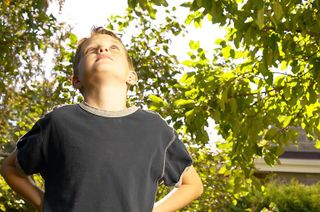
    Nine-year old Lawson is playing with his dog in the grassy area beyond his backyard. Mom yells from the back door, "Lawson, it's time to come in."

    Blog. boy looking up at tree. 2.09No response.

    "Lawson! Time to come in!"

    No response.

    Mom yells again. And again.

    Still no response. By now Mom feels her temperature rising, especially since she can see that her son is not far away and staring intently up at a tree.

    "Lawson James! You get yourself in here right now, young man!"

    Lawson takes his time coming in, a slight smile at the corners of his mouth. 

    His mother stands waiting, with hands on her hips. "You'd better have a good excuse, young man! Now you tell me why you didn't come when I called you!"

    "Well … I didn't hear you the first four times you called."

    Resistance comes in different packages

    Some kids plant their feet and holler, "No!" as if daring you to do anything about it. That kind of open defiance is easy to spot.

    Others are more subtle, like the child who appears smiling and compliant, but habitually "forgets." If this behavior is chronic don't immediately assume it's deliberate. For some, there's an underlying problem such as ADD or ADHD, which makes consulting a licensed professional a worthwhile idea.

    Some children quickly agree with you, often with a smile or laugh, but then don't do what they said they would do. Note: Both "forgetters" and "agrees, but doesn't do its" offer passive resistance. That's not as in-your-face as defiance, but these pint-sized human relations experts know parents find that easier to take.  

    The "Lawsons" of this world know exactly how far they can push Mom or Dad. They usually obey. Eventually. They'll give in when they are ready, that is, just before you blow your top. If this sounds like a battle of wills, that's exactly what it is. 

    Consider such tactics the child's way of exercising the limited power at their disposal. 

    Are these kids evil? No. They're human. That is, not perfect, like every other human being.

    Nobody said parenting would be easy

    Still, few of us realize ahead of time how long it can take to teach important lessons. We get tired and lose heart.

    We may ask ourselves, why bother to keep trying? The answer is easy. It's because all the studies show that youngsters who learn to obey and to respect authority have an easier time in school and also navigating through adolescence.

    No one formula exists, but here some general pointers:

        Principle one: Figure out what really matters in your family and talk about it.

        Principle two: Pick your battles carefully.

        Principle three: Don't say it unless you mean it. But if you say it, make it stick.

        Principle four: Be consistent. Whatever your rules were yesterday, stick with them today.  Otherwise, you start over tomorrow. Besides, children feel more secure when they don't have to wonder whether you mean it … this time. 

        Principle five: Learn to laugh.

    All the while you're teaching and modeling, without a word

    Any time you lose your temper or raise your voice, you hand over some of your authority as the parent. (Yes, I know how daunting and hard that is. I should, because I slipped up many times.)

    As I got better at staying focused I realized being consistent actually saved time–as well as my sanity. Otherwise, any kid with even minimal levels of spunk will keep testing you just to see if you still mean it.

    This tiresome maneuver can go on a very long time, especially with those children we label "strong-willed." If Dad and Mom stick to the limits they laid down, eventually even these guerilla fighters get bored and stop trying. 

    Parenting is a long-term course in personal growth

    Being in authority may make you uncomfortable, but remember, God gave you these children. He knows your stress levels and he equips you for the task He gives you. 

    As our children grow and we face new challenges, we parents continue to grow stronger from within. Stronger in character, with a clearer fix on what we as individuals stand for. Most of the time we also pick up all kinds of useful personal skills.

    When you feel overwhelmed, remember Paul's truth and take it to heart:

    "I can do everything through him who gives me strength." Philippians 4:13

    That includes living with a Resistance Fighter who happens to be your child.

    Take it from one who survived,

    Lenore

  •    Blog. Family watching TV. 2.15More is caught than taught.

    The first time I heard this catchy phrase the truth of it grabbed me. I thought immediately of parents and children.

    Sorry, that's too easy. This phrase applies to all of us. At any age and any stage of life.  

    Let's face it, each of us is a sponge. Without even thinking about it we soak up the moods and attitudes of people we spend time with.

    If that's true for adults, think how much more that applies to children and teens.

    Certainly they are less-experienced and therefore, likely to be more gullible. In the usual school situation, they spend their days absorbing what teachers and textbooks tell them is true.  

    All the while, multiple choices of social media are as close as their fingertips–and many of them are downright dangerous. Any time of day or night they can easily connect with information they assume comes from "people who know." 

    Are we adults any better?

    How often do we check our cell phones? Or the Internet? Some of us stay glued to the Internet or TV from waking to bedtime every day. Media stars, books, newspapers and magazines color our opinions, too.

    Celebrities rave–for pay–about certain products. Talk show hosts with time slots to fill interview authors of books sent to them (free) by publishers. And we take it all in, often without much thought about what we just saw and heard.

    Then you or I or the people next door just "happen" to buy said product or book.

    Our children take their cues from us 

    Almost from the moment our kids pop onto the scene we become their main role models. I wasn't ready for that. Were you? 

    In no time I learned that little ones are all eyes and ears–and they don't miss a thing. Especially our bad habits.

    In their early years youngsters want to be "just like Mommy" or "just like Daddy." That's why they galumph around the house wearing our way-too-big shoes.

    It's one of life's mysteries how a youngster can go straight from that stage (it seems) to adolescence, when they announce the last thing they want is to be like either parent. 

    What do we do then? Ron Taffel, described as "a child-rearing expert," nails it:

    Even as kids reach adolescence, they need more than ever for us to watch over them. Adolescence is not about letting go. It's about hanging on during a very bumpy ride.

    Still watching us 

    I used to think once our kids were grown we would have no influence on them. Not true.

    Even when they're adults who live perfectly fine lives on their own, our children unconsciously look to us as role models.

    In some instances that sounds contradictory, especially if a son or daughter seems bent on doing everything they can to be different from us.

    Think of it this way. They may keep an eye on what we do and say to track whether the standards we preached while they were growing up were just for them or for us, too. 

    When family tales are good for a laugh

    The bride was preparing a huge dinner for the couple's extended family. She planned to serve a baked ham and cut off the end of it before she put it in the baking pan. When her husband asked why, she answered, "Because Mom always did."

    When feast day arrived the young hostess asked, "Mom, I cut off the end of the ham like you always do and Jason asked why. I didn't know. Why did you always do that?"

    Her mother thought a bit. "I guess because Grandma always whacked off the end of the ham. Let's ask her."

    After Grandma stopped laughing she said, "Well, I had to. My only pan was too small for a big ham."

    That, my friends, is one of the ways lifestyles and funny little quirks can live on for generations.

    Every one of us is somebody's child

    We, too, carry around pluses and minuses we "caught" from our parents and childhood relationships. Sometimes it can take years before we understand that and see clearly. That makes it worth every once in awhile asking ourselves:

    How many traits and foibles of my parents do I still hang onto?

    Are they helping me or dragging me down?

    Which one(s) do I need to leave behind?

    If you want to shed some old thinking but you don't know how to change, don't give up. Here's the Good News: You don't have to do it on your own. You have Jesus on your side.

    Therefore, if anyone is in Christ, he is a new creation. The old has passed away; behold the new has come.  –2 Corinthians 5:17  ESV

    For I can do everything through Christ, who gives me strength.  –Philippians 4:13  NLT

    Start now, with baby steps. One at a time. Keep your eyes always focused on the One who makes all things new. 

    Best of all is when we can hang on to what was good in our growing-up years and combine it with what the Lord has taught us in our adult lives. 

    Learning and growing never stop–and aren't you glad of that?

    Lenore

  • Why would I say that? Because somebody, somewhere is watching you and listening in. Always.

    Blog. Mother. Arm around Teen. 10.19That thought brings us up short, doesn't it?

    Yet it's true, especially if we're a parent or if we spend much time around children and/or teens.  

    Young people are looking for clues and for role models as they try to figure out who they are.

    Adolescents and teens will deny that's true, yet surveys of young people reach mostly the same conclusion: Mothers and/or fathers top the list as the most important influence on their thinking and actions.

    Adult children take many of their cues from parents, too–even when they seem not to care. 

    Each of us influences other people–positively or negatively–more than we know.

    If you doubt it, look back and recall the people who affected you and your thinking, perhaps by just a chance encounter.

    Watch out for giving mixed messages

    That comes about when we say one thing to one person and something else to another.

    Picture the scene: A mom picks up her children from school and they stop for a snack. Mom runs into a friend so those two share a table while their kids occupy the table next to them.  

    Their youngsters do what kids always do: eavesdrop on adult conversation. Suppose the friend praises the latest edition of Oprah's magazine and Mom chimes in with, "Oh, what I'd give to have that woman's money! All those houses, all those people at her beck and call, what a life that would be!"

    Later that day her middle-school age daughter begs for a bigger allowance.

    Mom replies, "Your allowance is just fine. Remember, money isn't everything. You need to learn it can't buy happiness."

    Will her daughter remember what Mom said about Oprah's big bucks or what she says to her kids? 

    It's crucial to watch what we say, but first we need to be clear on what we believe and what we stand for. Then we won't give mixed messages.

    Because few kids are able to pick through and discern what's important to us, we need to talk about what's good and right and true in our everyday conversation. 

    For starters:

    • We point out individuals who demonstrate integrity in small ways as well as big 
    • We stay alert to notice when one of our kids acts kindly or considerately, and hand out some praise
    • We make sure to tell others about our child's positive acts and let them hear us  

    What about grades?

    Keep them in perspective.

    Kids may study hard and do their best, yet fall short of being tops in their class. Let that be enough–and say so. 

    (Isn't that what we tell them, that we only want them to study hard and do their best?)

    When grades alone top the list, the pressure to cheat increases. So does the feeling of not measuring up. 

    Whether it's academics or deeds of kindness it's good to applaud the effort, whatever the results. "You worked hard, didn't you?" is music to the heart.

    If we search out things we admire and speak of it, our words will encourage our kids to repeat them.  

    School is one thing, life is another

    Every part of it gets easier when we have a personal cheering section, at any age. Words matter. So do hugs.  

    Remember these words from the Apostle Paul?

    Therefore encourage one another and build one another up, just as you are doing.–1 Thessalonians 5:11

    Our kids need to know we love them, not when, not if, but as they are.

    Children respond to that as a plant responds to sunshine. So do husbands and wives. And friends and parents. And all the people in our lives. 

    Everyone. Everywhere. In every situation.

    Here's to shining the love of Jesus brightly in our lives. That's what makes the best kind of hero.

    Lenore

  • Most parents want their kids to sail through childhood and adolescence trouble-free, then grow up to be strong, right-thinking adults.

    Blog. Family sitting on rocks. 1.15But how can we do that?

    Forget checking Google for THE perfect formula for each individual child.

    There is no such thing.

    How could there be? The Bible tells us every human being is one-of-a-kind, fearfully and wonderfully made.

    That's why every parent with more than one child soon discovers what they learned with Child A isn't much help with Child B. 

    Besides, no one has discovered a way to spare our kids the pain of learning by experience. 

    What we can do is give them a solid start and help them find their own way.

    Everything rests on planting truths that endure 

    Whatever the ages of our children, we start now. With ourselves.  
    We make a conscious effort to live out the values we say we want them to have.
     
    If we talk it but don't live it, our words are just words.
    You see, every child comes equipped with the ability to spot hypocrisy and they're quick to point it out. Especially when Mom or Dad says say one thing but does another. 
     
    Most parents hear this often: "But you said . . . ."
     
    This is exhausting, but it carries a bonus. As we try to be good role-models we grow stronger from within.
     
    And so do our children. 
     
    Begin by thinking through what you believe as parents  
     
    Make a checklist of what your family stands for–or what you want your family to stand for: 
     
    Try these for starters:
    • Always tell the truth. (Nobody gets in trouble for being honest.)  
       
    • Be kind and thoughtful in what you say and do.
    • Be fair. Remember, other people have the same rights as you.
    • Respect those in authority. (Explain "authority.") 
    • Treat others the way you want them to treat you.

    Consider these to be foundation stones, a solid base to build a life on. 

    A quartet of Bible verses for backup

    [Jesus said] "And as you wish that others would do to you, do so to them."  Luke 6:31  ESV  

    Even children are known by the way they act, whether their conduct is pure and right.  –Proverbs 20:11  NLT

    If we confess our sins, he is faithful and just and will forgive us our sins and purify us from all unrighteousness.  –1 John 1:9  NIV

    I can do all things through him who strengthens me. –Philippians 4:13  ESV

    Empower your kids by helping them understand that everything is a choice

    Stress this core principle of living strong until it becomes theirs, too: 

    In every situation, we make a choice. If nothing else, we choose how we will react.

    That's a statement of personal power if ever there was one, useful even for younger kids.

    It can make a child or teenager feel less vulnerable. A youngster or teen who understands this is less likely to plead that someone makes them feel a certain way or makes them hang with a pal they know is headed the wrong way. 

    They will know they alone choose their actions and responses. 

    Take it one step further. Teach them every choice, wise or foolish, inevitably yields a consequence, good or bad.  

    Best of all, we know and pass on the reason(s) for right living

    It's natural for children and teens to consider their own moods and desires more important than anything else. They need a reference point outside personal feelings.

    Even young children can understand that as believers we want to reflect Jesus in how we live and treat others.

    Will we parents fall short? Of course.

    Will our children grow up perfect? Never.

    We're all human beings, remember?

    It helps to be involved in a strong church that teaches the Truth

    This provides a natural setting in which we can make friends who share our values. And so can our children and teens.

    There we get reminded that Jesus died to pay for our failures and that we're forgiven, a.k.a., grace. 

    We get pointed to Bible truths like 2 Corinthians 5:17:

    Therefore, if anyone is in Christ, he is a new creation. The old has passed away; behold, the new has come.  

    Our children need to hear that as they grow and learn–and make mistakes. It's what we parents need, too, and for the same reason.

    The grace of forgiveness in Jesus enables us to keep going and to know we don't have to drag around our past mistakes any more.

    Could there be a better Truth to help our children make it through life?

    Still growing,

    Lenore