Category: Children

  • Let's face it. Some children simply refuse to give in–or give up.

    Blog. Dad. Daughter. 8.18A friend remarked, "My two brothers and I loved to scrap and we were always pestering each other.   

    "My folks would let it go on as long as they could stand it, I guess. Then one of them would say, 'CUT THAT OUT!'

    "That was my mom and dad's magic phrase. When we kids heard those three little words we knew we'd better stop or we'd be in a world of trouble.

    "I know now it wasn't the specific words they used," he said. "It was their don't-push-it! tone of voice. That told us they were out of patience."

    Most of us use way too many words

    I remember doing exactly that, thinking it sounded more kind and loving and reasonable.  Now I know all it does is confuse and water down what we say. 

    Dr. James Dobson, founder of Focus on the Family, once said every child is a 24-hour a day student of his or her parents. 

    This careful study enables our children to know exactly how far they can go with each parent. They know which one is more likely to be swayed by pleading and which one needs all the facts–and time–before saying, "Yes."  

    It's a bit shocking–but accurate–that we train our kids to know how far they can push us.  

    Personalities play a part  

    For some strong-willed youngsters it's as if their mission in life is to oppose whatever Mom or Dad say. 

    Here's a word of comfort. These, um, "determined individuals" often grow into adolescents who are less susceptible to peer pressure and then become adults who love a challenge and don't wimp out.

    I can hear you saying, "That's all well and good, but this being in charge role doesn't fit my personality and it's really hard for me. How do I get through today?"

    Today remind yourself that every child secretly wants their parents to, well, act like parents. 

    We moms and dads are meant to be in charge, because we are their security.

    Knowing what their parents allow–and don't allow–makes youngsters feel safe and loved and cared for.

    This includes your prizefighter strong-willed child who never gives in gracefully. 

    We bless our children when we draw up boundaries

    Boundaries, like fences, protect. Well thought-out rules tell our kids that we love them enough to keep them safe and secure.  

     Within those reliable limits our children can relax and run free. 

    Will they keep testing to see whether we still mean it? You betcha. That's just part of being a kid.

    That's why it's essential to be consistent. (This is any parent's biggest challenge.)  

    If it was a No yesterday, it has to be a No today–or you'll be back at the beginning and starting over.

    We don't need to act like dictators, nor yell.

    Just remember that we are the grownups in the family and that's our job.

    It's all about knowing who we are, then acting like we believe we possess the authority 

    And we do. From God.

    Children, obey your parents in everything, for this pleases the Lord.  -Colossians 3:20 ESV

    As loving caretakers of the children God gave us we are to protect them and guide them because it's for their good. Our job as parents is to get our children equipped and ready to move out into a life of their own one day. 

    And we do it all with love.

    Put on then, as God's chosen ones, holy and beloved, compassion, kindness, humility, meekness and patience, bearing with one another . . .    Colossians 3:12-13a

    Parenting roles change over the years 

    In the earlier years we must be watchful at all times, in every detail. From feeding and diapering, then chasing them as toddlers, we're all about tender care and protection. 

    As our children get older we still keep a watchful eye, but our role gets more subtle, Little by little, we back off and stay more in the background so each child gains confidence that they can handle whatever they're trying to do.

    All along we remain their protectors, their defenders, their life coaches and sometimes, yes, The Enforcers.

    Be sure of this: Even teenagers know they're not ready to be on their own, although they will argue the point over and over and over. Most of the time they avoid saying they need us and feel safer because we're watching our for them.

    Nevertheless, it's worth repeating: Our kids push us to the edge because they want us to be who God asks us to be.

    Wherever we are in this equation, we are not alone

    Being a parent and watching our children grow into themselves is deep-down satisfying. I believe it's the most important thing we could ever do because we are raising human beings.

    But parenting is never a picnic. It isn't meant to be. Raising our children is it's a growth-and-development project for us as individuals, too. Being a parent changes us, makes us wiser and stronger and more understanding of human nature.

    (Is it any wonder that we Christian parents so often feel inadequate and frequently ask Jesus to guide us and help us?)

    Over the years when I've felt weak and insecure, I've gone back again and again to Ephesians 3:20:

    Now to him who is able to do far more abundantly than all that we ask or think, according to the power at work within us, to him be glory in the church and in Christ Jesus throughout all generations, forever and ever. Amen.  ESV  

    It's safe to say that applies to being a mom or a dad, too.

    Here's to being who God made you to be–and enjoying it! 

    I'm praying for you,

    Lenore
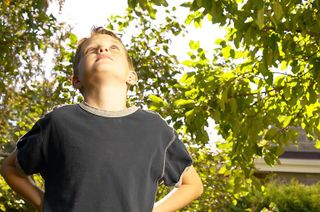
  • That may sound like an extreme statement, but here's a true-life story that illustrates the point. 

    Nine-year old Lawson is playing with his dog in the grassy area beyond his backyard. Mom yells from the back door, "Lawson, it's time to come in."

    Blog. boy looking up at tree. 2.09No response.

    "Lawson! Time to come in!"

    No response.

    Mom yells again. And again.

    Still no response. By now Mom feels her temperature rising, especially since she can see that her son is not far away and staring intently up at a tree.

    "Lawson James! You get yourself in here right now, young man!"

    Lawson takes his time coming in, a slight smile at the corners of his mouth. 

    His mother stands waiting, with hands on her hips. "You'd better have a good excuse, young man! Now you tell me why you didn't come when I called you!"

    "Well … I didn't hear you the first four times you called."

    Resistance comes in different packages

    Some kids plant their feet and holler, "No!" as if daring you to do anything about it. That kind of open defiance is easy to spot.

    Others are more subtle, like the child who appears smiling and compliant, but habitually "forgets." If this behavior is chronic don't immediately assume it's deliberate. For some, there's an underlying problem such as ADD or ADHD, which makes consulting a licensed professional a worthwhile idea.

    Some children quickly agree with you, often with a smile or laugh, but then don't do what they said they would do. Note: Both "forgetters" and "agrees, but doesn't do its" offer passive resistance. That's not as in-your-face as defiance, but these pint-sized human relations experts know parents find that easier to take.  

    The "Lawsons" of this world know exactly how far they can push Mom or Dad. They usually obey. Eventually. They'll give in when they are ready, that is, just before you blow your top. If this sounds like a battle of wills, that's exactly what it is. 

    Consider such tactics the child's way of exercising the limited power at their disposal. 

    Are these kids evil? No. They're human. That is, not perfect, like every other human being.

    Nobody said parenting would be easy

    Still, few of us realize ahead of time how long it can take to teach important lessons. We get tired and lose heart.

    We may ask ourselves, why bother to keep trying? The answer is easy. It's because all the studies show that youngsters who learn to obey and to respect authority have an easier time in school and also navigating through adolescence.

    No one formula exists, but here some general pointers:

        Principle one: Figure out what really matters in your family and talk about it.

        Principle two: Pick your battles carefully.

        Principle three: Don't say it unless you mean it. But if you say it, make it stick.

        Principle four: Be consistent. Whatever your rules were yesterday, stick with them today.  Otherwise, you start over tomorrow. Besides, children feel more secure when they don't have to wonder whether you mean it … this time. 

        Principle five: Learn to laugh.

    All the while you're teaching and modeling, without a word

    Any time you lose your temper or raise your voice, you hand over some of your authority as the parent. (Yes, I know how daunting and hard that is. I should, because I slipped up many times.)

    As I got better at staying focused I realized being consistent actually saved time–as well as my sanity. Otherwise, any kid with even minimal levels of spunk will keep testing you just to see if you still mean it.

    This tiresome maneuver can go on a very long time, especially with those children we label "strong-willed." If Dad and Mom stick to the limits they laid down, eventually even these guerilla fighters get bored and stop trying. 

    Parenting is a long-term course in personal growth

    Being in authority may make you uncomfortable, but remember, God gave you these children. He knows your stress levels and he equips you for the task He gives you. 

    As our children grow and we face new challenges, we parents continue to grow stronger from within. Stronger in character, with a clearer fix on what we as individuals stand for. Most of the time we also pick up all kinds of useful personal skills.

    When you feel overwhelmed, remember Paul's truth and take it to heart:

    "I can do everything through him who gives me strength." Philippians 4:13

    That includes living with a Resistance Fighter who happens to be your child.

    Take it from one who survived,

    Lenore

  • A lot of moms tell me they wish they could go back and start again–if they could already be equipped with what they know now.  

    "Next time," they say, "I wouldn't get so uptight, always wondering if I was doing it right. I would be calmer, more patient. I would just enjoy every moment so much more!"

    Blog. Mom. 3 generations. 5.16 (2017_08_21 00_15_50 UTC)Can you identify with that feeling? I can. 

    I loved our four daughters with all my heart and sincerely tried to be a good mom. Later I understood that I tried so hard I made myself uptight.

    If I were starting over . . .

    First of all, I'd relax, knowing it's more important to get enough rest and stay cheerful than to be sure no dust bunnies hide in the corners.

    My To Do list would take second place to the joy of simply being there. Being present with the children God gave us and letting myself experience the joy more fully.

    Yes I know, that sounds kind of other-worldly.

    The truth is, there's nothing more real than taking joy in the moment in which you are living.  The joy of watching each child's personality come through. 

    Sometimes we parents ask ourselves, Who are these little people? That can't be clearly defined, since every person is a combination of all the family members who went before, not just their birth mother and father.

    It's a mystery and a joy–if we let it be.

    We moms get to be in on this unfolding. We get to care for and guide and influence these mystery beings who in one sense march to their own drummers and in another, march to whatever tune we pipe their way.

    That's a heavy responsibility. And an awesome privilege.

    We see the parts, not the whole of our children's lives

    We can't foresee how quickly our little ones will grow up, take control of their lives and make their own decisions. At first I imagined what our girls thought or did would be an extension of my husband and me and what they'd learned in our home.

    It wasn't long before I realized that each one was her own person. That showed even more clearly as they grew into the teenage years and became adults.

    I shouldn't have been surprised. Hadn't I always said God only creates one of a kind?  

    Being a mom is an exercise in giving

    Not one of us who's a mom comes out of it the same as we went in.

    And that's a good thing!

    Being a mom quickly throws ice water on any traces of a me-centered mode of living. Screaming babies who need to be nursed or have their diapers changed bring an urgency that supersedes our own needs. 

    Through all the years . . .

    We keep learning and growing, stretching to accommodate what sometimes strikes us as the "shocking ideas" of our kids and grandkids. Still, we want to be fair so we evaluate it. Often we find ourselves thinking, Hmmm. I never thought of it that way.

    That's a good thing. It keeps us from growing barnacles as we sit in our safe harbor of already knowing absolutely what we think about everything.

    God never meant us to stay stuck in our thinking. At any age He expects us to be growing, because only He knows what He would have us become over a lifetime.

    Whatever age your children or mine may be, however we may applaud or decry their lifestyles, only God can see the whole of their lives. And so we keep praying.

    Our kids bring out our best side

    Poet Roy Croft wrote a poem titled "Love." It's often used at weddings, but I think these lines express what many of us would say as we think about how rearing our children has changed us: 

    I love you,
    Not only for what you are,
    But for what I am
    When I am with you.
    I love you,
    Not only for what
    You have made of yourself,
    But for what
    You are making of me.
    I love you
    For the part of me
    That you bring out ...

    Being a mother changes us

    Our children grow and so do we. That's reason enough to thank God.

    None of us knows what tomorrow will bring. Don't let this Mother's Day pass without expressing your love to your mother while you can.

    From now on let it become your resolve to write your children and tell them what they mean to you and how proud you are to be their mom–not just on Mother's Day, but every day. You will bless their lives and also your own.

    Love never needs a special day as an excuse to be spoken. Or written. So any day of the year let your love flow freely. The more you give away, the more you get back. 

    And wouldn't each child, whatever their age, welcome a bit of extra encouragement and assurance from their mom? 

    Blessings and much joy to you,

    Lenore

  •    Blog. Family watching TV. 2.15More is caught than taught.

    The first time I heard this catchy phrase the truth of it grabbed me. I thought immediately of parents and children.

    Sorry, that's too easy. This phrase applies to all of us. At any age and any stage of life.  

    Let's face it, each of us is a sponge. Without even thinking about it we soak up the moods and attitudes of people we spend time with.

    If that's true for adults, think how much more that applies to children and teens.

    Certainly they are less-experienced and therefore, likely to be more gullible. In the usual school situation, they spend their days absorbing what teachers and textbooks tell them is true.  

    All the while, multiple choices of social media are as close as their fingertips–and many of them are downright dangerous. Any time of day or night they can easily connect with information they assume comes from "people who know." 

    Are we adults any better?

    How often do we check our cell phones? Or the Internet? Some of us stay glued to the Internet or TV from waking to bedtime every day. Media stars, books, newspapers and magazines color our opinions, too.

    Celebrities rave–for pay–about certain products. Talk show hosts with time slots to fill interview authors of books sent to them (free) by publishers. And we take it all in, often without much thought about what we just saw and heard.

    Then you or I or the people next door just "happen" to buy said product or book.

    Our children take their cues from us 

    Almost from the moment our kids pop onto the scene we become their main role models. I wasn't ready for that. Were you? 

    In no time I learned that little ones are all eyes and ears–and they don't miss a thing. Especially our bad habits.

    In their early years youngsters want to be "just like Mommy" or "just like Daddy." That's why they galumph around the house wearing our way-too-big shoes.

    It's one of life's mysteries how a youngster can go straight from that stage (it seems) to adolescence, when they announce the last thing they want is to be like either parent. 

    What do we do then? Ron Taffel, described as "a child-rearing expert," nails it:

    Even as kids reach adolescence, they need more than ever for us to watch over them. Adolescence is not about letting go. It's about hanging on during a very bumpy ride.

    Still watching us 

    I used to think once our kids were grown we would have no influence on them. Not true.

    Even when they're adults who live perfectly fine lives on their own, our children unconsciously look to us as role models.

    In some instances that sounds contradictory, especially if a son or daughter seems bent on doing everything they can to be different from us.

    Think of it this way. They may keep an eye on what we do and say to track whether the standards we preached while they were growing up were just for them or for us, too. 

    When family tales are good for a laugh

    The bride was preparing a huge dinner for the couple's extended family. She planned to serve a baked ham and cut off the end of it before she put it in the baking pan. When her husband asked why, she answered, "Because Mom always did."

    When feast day arrived the young hostess asked, "Mom, I cut off the end of the ham like you always do and Jason asked why. I didn't know. Why did you always do that?"

    Her mother thought a bit. "I guess because Grandma always whacked off the end of the ham. Let's ask her."

    After Grandma stopped laughing she said, "Well, I had to. My only pan was too small for a big ham."

    That, my friends, is one of the ways lifestyles and funny little quirks can live on for generations.

    Every one of us is somebody's child

    We, too, carry around pluses and minuses we "caught" from our parents and childhood relationships. Sometimes it can take years before we understand that and see clearly. That makes it worth every once in awhile asking ourselves:

    How many traits and foibles of my parents do I still hang onto?

    Are they helping me or dragging me down?

    Which one(s) do I need to leave behind?

    If you want to shed some old thinking but you don't know how to change, don't give up. Here's the Good News: You don't have to do it on your own. You have Jesus on your side.

    Therefore, if anyone is in Christ, he is a new creation. The old has passed away; behold the new has come.  –2 Corinthians 5:17  ESV

    For I can do everything through Christ, who gives me strength.  –Philippians 4:13  NLT

    Start now, with baby steps. One at a time. Keep your eyes always focused on the One who makes all things new. 

    Best of all is when we can hang on to what was good in our growing-up years and combine it with what the Lord has taught us in our adult lives. 

    Learning and growing never stop–and aren't you glad of that?

    Lenore

  • Awhile back a group of us were talking about growing up.

    We found ourselves dissecting whether how we grew up influences who we are now.

    Some said it does, but "Nick" disagreed, "Not me. I'm a self-made man. I'm an adult and I decide how I want to live."

    "Ellie" spoke softly, "That's not as easy as it sounds. My mom used to freeze Blog. PensiveAuburnWoman. 4.12us out when we misbehaved. I hated that!

    "Once I had children, without even thinking about it I found myself going all cold and silent when they acted up. Thank God I realized where that came from.

    "Even so, it took me a lot of years and a lot of prayer to learn to stop myself and stay calm. For me, those old patterns from childhood die hard."

    Heads nodded all around the room.

    Then "Linda" said, "I see that in my husband. He's just like his dad. Neither one of them can turn off their work and just relax."

    After that everyone in the room had a story of how their growing-up years influenced them as adults. Sometimes in a good way, sometimes not.

    We leave imprints on our children, too

    Most of us start out wanting to be good parents. We intend for our daughters and sons to grow up healthy and balanced, with sound values and faith that will carry them through whatever comes.

    The trouble is we're human. We slip up and give way to our feelings. Our frustrations spill over into everyday family life.

    Without even trying, our kids pick up the best of us. And the worst of us.

    What about all those "little talks" when we think we're teaching them about right and wrong and how to live? Family counselors say they're not so memorable.

    What about social media?

    Yes, the many forms of social media play a big part in the lives of many young people–and often not for good. Yet all the research from countless well-documented studies come to the same conclusion.

    Parents are the most important influence in a youngster's life.

    What impacts our children most deeply is how we live and what we say all those everyday times we think they're paying no attention.

    Parenting would be easier if we were rearing peas in a pod

    God created each of our children (and each of us) one-of-a-kind. That's a wonderful thing and who would want it otherwise?

    Practically speaking it means what you learned with Child A probably won't work as well with Child B.  

    Whether your children came by birth, adoption or through marriage it helps to remember that God gave you each child.

    Even if you can't quite figure out one of them.

    Even if another one "drives you crazy."

    What's more, He equips you to be the mom or dad who loves and helps shape these particular young individuals.

    Take courage from knowing that through it all God is teaching and growing you as an individual. 

    As one observer put it, children grow up. Parents grow deeper, wiser, much more understanding of human nature.

    Viewing our own parents through an adult perspective

    It helps to take a fresh look and realize our mother and/or father dealt with stresses and problems we didn't see and couldn't have understood.

    Our imperfect parents made mistakes, just as we do. They coped as well as they could manage. Loved their kids as well as they were able.

    Don't we do the same?

    You and I can count up all the ways our inadequate mom or dad hurt us and/or let us down and spend the rest of our lives nursing our pain.

    Or we can sift out the good and give thanks, then pray our children will do the same for us.

    Drawing strength whenever we need it

    Anytime you think you're in over your head, remember who gifted you with each child. Remember who your children are–and who you are: 

    For you created my inmost being; you knit me together in my mother's womb. I praise you because I am fearfully and wonderfully made.   Psalm 139:13-14  NIV

    For we are God's workmanship, created in Christ Jesus to do good works, which God prepared in advance for us to do. Ephesians 2:10  NIV

    Program your mind for your life now 

    Spend some time in your Bible. When you find a verse that touches your heart, find a way to hang onto it. Write it down. Enter it into your phone or your computer, wherever you can find it quickly.

    Even better, store at least a few in your memory. Then you'll be ready whenever old thinking creeps in.

    Whenever you feel shaky or uncertain I promise it will help to read those verses aloud or just in your mind.

    Think of it as planting a new reality in your mind and heart.

    Think of it as finding a way to forgive the past and move on.

    Still learning, too,

    Lenore

  • This time let me spin a fictional account drawn from a real-life experience, which has something to say to all of us.  

    Picture the beginning of the school year at Spring Street School:

    Blog. Teacher with student. 8. 15When brand-new teacher Angie White stopped by Principal Green's office his assistant, Sue Timms, handed her a stack of file folders.

    "You'll be replacing Martha Black, who just retired. She had your fourth-graders as third-graders last year and she kept these notes on students and class materials.

    "I'm not allowed to give you those students' grades. We never do because we want teachers and students to start fresh."

    As Angie walked to her new classroom she thought, What a nice surprise. Maybe I'll find some clues to help me get off to a good start.

    As she leafed through the folders she noticed a handwritten list of student names. Some had asterisks and some were underlined. Hmm. I'll bet these were Mrs. Black's favorites, maybe the brightest ones, or the most responsible. So many above-average kids, what fun!

    The next Monday Miss Angie greeted each child with a big smile and a name tag. At day's end she thought, I was right. These kids are great!  

    It wasn't long other teachers noted her upbeat attitude. "Well, she's a newbie," said Miss Mary to Miss Liz. "Remember when we thought we could change the world? She'll hit reality soon enough."

    Months later, at the end of the school year:

    Retired teachers were invited to the closing assembly. Afterward, Miss Angie rushed over to meet Dorothy Black. "I'm Angie White, the fourth-grade teacher who inherited your wonderful class. Thank you so much for leaving that list of students and for identifying the brightest students. Those kids are born leaders."

    Dorothy Black stared at her. "My wonderful class? My dear, you can't be talking about the children I had last year. They were the main reason I retired a year early." 

    Angie White's forehead creased. "But your list . . .  I mean, at first I was puzzled what those asterisks meant next to certain names. Then I guessed you must be pointing to the top students in the class. 

    "And you were right-on! No matter what challenge I gave those students they out-performed. They sparked the other kids to learn, too.

    "I've been so privileged to have a class like that in my first year of teaching. I'm afraid they've spoiled me for average kids."

    Dorothy Black shook her head

    "I'm confused. Please, give me some names."  

    Miss Angie started reeling off names, her eyes shining. When she finished, Miss Black took her hand. "My dear, you just named my problem children. The incorrigible ones. The ones who never turned in their homework. That's what the asterisks stood for.

    "Sandra Smith warned me what I was in for because she had those students as second-graders. She let me know which children were below-par or real behavior problems–and she was absolutely right. Last year was incredibly hard for me. To tell the truth, I'm not sure how I made it through the school year." 

    Angie White couldn't think what to say. The silence stretched on.

    At last Dorothy Black blotted her eyes and stammered, "Perhaps those children simply lived up to my expectations.

    "And my dear, they also lived up to yours."

    This tale of human nature has meaning for all of us   

    It's easy to go around expecting the worst from people and from life. It takes no effort at all to become negative in our thinking. Before long we've settled into a pattern of looking at people and life through dark-colored glasses. 

    And who wants to live like that day after day?

    The Apostle Paul shows us how to overcome that trap: 

    Finally, brothers [and sisters,] whatever is true, whatever is noble, whatever is right, whatever is pure, whatever is lovely, whatever is admirable–if anything is excellent or praiseworthy–think about such things. Philippians 4:8  NIV

    If we daily follow his advice it will lift our outlook on life and people. 

    And wouldn't we more likely enjoy our lives?

    Here's to being a "Miss Angie" in the place where we are and letting ourselves see how blessed we are!

    Praying for all of us,

    Lenore

  • Why would I say that? Because somebody, somewhere is watching you and listening in. Always.

    Blog. Mother. Arm around Teen. 10.19That thought brings us up short, doesn't it?

    Yet it's true, especially if we're a parent or if we spend much time around children and/or teens.  

    Young people are looking for clues and for role models as they try to figure out who they are.

    Adolescents and teens will deny that's true, yet surveys of young people reach mostly the same conclusion: Mothers and/or fathers top the list as the most important influence on their thinking and actions.

    Adult children take many of their cues from parents, too–even when they seem not to care. 

    Each of us influences other people–positively or negatively–more than we know.

    If you doubt it, look back and recall the people who affected you and your thinking, perhaps by just a chance encounter.

    Watch out for giving mixed messages

    That comes about when we say one thing to one person and something else to another.

    Picture the scene: A mom picks up her children from school and they stop for a snack. Mom runs into a friend so those two share a table while their kids occupy the table next to them.  

    Their youngsters do what kids always do: eavesdrop on adult conversation. Suppose the friend praises the latest edition of Oprah's magazine and Mom chimes in with, "Oh, what I'd give to have that woman's money! All those houses, all those people at her beck and call, what a life that would be!"

    Later that day her middle-school age daughter begs for a bigger allowance.

    Mom replies, "Your allowance is just fine. Remember, money isn't everything. You need to learn it can't buy happiness."

    Will her daughter remember what Mom said about Oprah's big bucks or what she says to her kids? 

    It's crucial to watch what we say, but first we need to be clear on what we believe and what we stand for. Then we won't give mixed messages.

    Because few kids are able to pick through and discern what's important to us, we need to talk about what's good and right and true in our everyday conversation. 

    For starters:

    • We point out individuals who demonstrate integrity in small ways as well as big 
    • We stay alert to notice when one of our kids acts kindly or considerately, and hand out some praise
    • We make sure to tell others about our child's positive acts and let them hear us  

    What about grades?

    Keep them in perspective.

    Kids may study hard and do their best, yet fall short of being tops in their class. Let that be enough–and say so. 

    (Isn't that what we tell them, that we only want them to study hard and do their best?)

    When grades alone top the list, the pressure to cheat increases. So does the feeling of not measuring up. 

    Whether it's academics or deeds of kindness it's good to applaud the effort, whatever the results. "You worked hard, didn't you?" is music to the heart.

    If we search out things we admire and speak of it, our words will encourage our kids to repeat them.  

    School is one thing, life is another

    Every part of it gets easier when we have a personal cheering section, at any age. Words matter. So do hugs.  

    Remember these words from the Apostle Paul?

    Therefore encourage one another and build one another up, just as you are doing.–1 Thessalonians 5:11

    Our kids need to know we love them, not when, not if, but as they are.

    Children respond to that as a plant responds to sunshine. So do husbands and wives. And friends and parents. And all the people in our lives. 

    Everyone. Everywhere. In every situation.

    Here's to shining the love of Jesus brightly in our lives. That's what makes the best kind of hero.

    Lenore

  • Most parents want their kids to sail through childhood and adolescence trouble-free, then grow up to be strong, right-thinking adults.

    Blog. Family sitting on rocks. 1.15But how can we do that?

    Forget checking Google for THE perfect formula for each individual child.

    There is no such thing.

    How could there be? The Bible tells us every human being is one-of-a-kind, fearfully and wonderfully made.

    That's why every parent with more than one child soon discovers what they learned with Child A isn't much help with Child B. 

    Besides, no one has discovered a way to spare our kids the pain of learning by experience. 

    What we can do is give them a solid start and help them find their own way.

    Everything rests on planting truths that endure 

    Whatever the ages of our children, we start now. With ourselves.  
    We make a conscious effort to live out the values we say we want them to have.
     
    If we talk it but don't live it, our words are just words.
    You see, every child comes equipped with the ability to spot hypocrisy and they're quick to point it out. Especially when Mom or Dad says say one thing but does another. 
     
    Most parents hear this often: "But you said . . . ."
     
    This is exhausting, but it carries a bonus. As we try to be good role-models we grow stronger from within.
     
    And so do our children. 
     
    Begin by thinking through what you believe as parents  
     
    Make a checklist of what your family stands for–or what you want your family to stand for: 
     
    Try these for starters:
    • Always tell the truth. (Nobody gets in trouble for being honest.)  
       
    • Be kind and thoughtful in what you say and do.
    • Be fair. Remember, other people have the same rights as you.
    • Respect those in authority. (Explain "authority.") 
    • Treat others the way you want them to treat you.

    Consider these to be foundation stones, a solid base to build a life on. 

    A quartet of Bible verses for backup

    [Jesus said] "And as you wish that others would do to you, do so to them."  Luke 6:31  ESV  

    Even children are known by the way they act, whether their conduct is pure and right.  –Proverbs 20:11  NLT

    If we confess our sins, he is faithful and just and will forgive us our sins and purify us from all unrighteousness.  –1 John 1:9  NIV

    I can do all things through him who strengthens me. –Philippians 4:13  ESV

    Empower your kids by helping them understand that everything is a choice

    Stress this core principle of living strong until it becomes theirs, too: 

    In every situation, we make a choice. If nothing else, we choose how we will react.

    That's a statement of personal power if ever there was one, useful even for younger kids.

    It can make a child or teenager feel less vulnerable. A youngster or teen who understands this is less likely to plead that someone makes them feel a certain way or makes them hang with a pal they know is headed the wrong way. 

    They will know they alone choose their actions and responses. 

    Take it one step further. Teach them every choice, wise or foolish, inevitably yields a consequence, good or bad.  

    Best of all, we know and pass on the reason(s) for right living

    It's natural for children and teens to consider their own moods and desires more important than anything else. They need a reference point outside personal feelings.

    Even young children can understand that as believers we want to reflect Jesus in how we live and treat others.

    Will we parents fall short? Of course.

    Will our children grow up perfect? Never.

    We're all human beings, remember?

    It helps to be involved in a strong church that teaches the Truth

    This provides a natural setting in which we can make friends who share our values. And so can our children and teens.

    There we get reminded that Jesus died to pay for our failures and that we're forgiven, a.k.a., grace. 

    We get pointed to Bible truths like 2 Corinthians 5:17:

    Therefore, if anyone is in Christ, he is a new creation. The old has passed away; behold, the new has come.  

    Our children need to hear that as they grow and learn–and make mistakes. It's what we parents need, too, and for the same reason.

    The grace of forgiveness in Jesus enables us to keep going and to know we don't have to drag around our past mistakes any more.

    Could there be a better Truth to help our children make it through life?

    Still growing,

    Lenore

  • The other day I talked with the frazzled mom of a couple of teens 

    Immediately, memory swept me back to the always-challenging days when three of our four kids were teenagers. Back then I often wondered whether I'd make it through. If only we had known at the beginning what we figured out by the end. Blog. Mother w. teenage daughter. 10.12

    Nobody ever does.

    The good news is that teen-age is a passage, not a life sentence for either parent or child.

    Hang on to that. (It will keep you sane.)   

    A new relationship lies just ahead.  

    Today's mutual frustration will pass, not on a predictable timetable because personalities differ. But one day you and your child will relate to each other as adult to adult, actually enjoying each other's presence.

    Trust me, it can happen–and usually does. 

    Here's a bit of what we picked up along the way

    * There are no cookie-cutter teens

    Every adolescent insists on steering through these years in his or her own way.

    As parents it helps to start the day by asking God's blessing and guidance, then taking an "energy drink" from God's Word like Philippians 4:13:

    I can do everything through him who gives me strength.

    Repeat as often as needed throughout the day.

    * Conflict is part of the transition process  

    I remember thinking, I can't say or do anything right! (This went on for years.) I felt overwhelmed by what seemed everlasting conflicts.

    I learned it helps to step outside ourselves and walk a mile in our kid's flip-flops.

    Those youngsters who now look us in the eye are as surprised as we are. They, too, are baffled by their mood swings, by one minute sounding adult and mature and the next like a whiny toddler. They don't understand themselves and that's part of what makes them so testy.

    We never know what to expect of them, true, but neither do they. 

    *The closer adolescents feel to their parents, the harder they find it to see themselves as separate individuals 

    One teen we knew, um, very well went to bed one night a sweet, loving girl. Next morning an individual who looked the same came to breakfast and slammed every door along the way–hard. This went on for a year and a half.

    Hostility for no reason.

    Total shock for parents.

    Then a family counselor friend explained it's as if teens must "build a case" in order to give them courage to separate themselves from loving parents. That helped us get a better perspective.

    We pledged to keep on loving, no matter what and this verse became our motto:

    Above all, love each other deeply, because love covers over a multitude of sins.                    -1 Peter 4:8 

    * Trying to exert tighter control usually backfires

    Our child's rebellion makes us want to clamp down, just to show who's in charge. Adolescents with an ounce of spunk react by digging in even deeper. They think their moms and dads still view them as little kids and want to hold them back. 

    It's more effective to back off on what isn't harmful. As one mom put it, "I'm strict on what really matters, but I don't get upset over small stuff. If he wants to spray his hair green or go to school in holey jeans I let it go." 

    Young birds need to try their wings. So do teens, preferably before they leave the nest. 

     * Loosen the cords and slowly play out the line

    Trot out a tested principle of parenting: With freedom comes responsibility.

    Put another way, increased freedom is a privilege, not a perk that automatically comes at a given age.

    So we keep track of their everyday behavior as a gauge of their level of maturity. Whether they keep their word. Whether they demonstrate kindness toward others without being reminded. Whether they abide by our house rules without being nagged.  

    We respond to their trust-worthiness by slowly doling out freedoms. Taking the family car, for example, comes after proving oneself reliable and responsible in many other ways. 

    It's similar to what Jesus said: 

    "Whoever can be trusted with very little can also be trusted with much, and whoever is dishonest with very little will also be dishonest with much."  –Luke 16:10

    Hang in there. You are not alone. God gave you each of your children and He will carry you through. Count on it.

    With love,

    Lenore    


  • Dear Moms,

    Trust me: It's all worth it!

    You recognize the sweet moments of mothering for what thBlog. Mom cooking w. child. 7.11ey are.

    Here's what I know now that I missed when our children were growing up:

    The not-so-sweet moments are worth just as much. 

    From this vantage point I understand that every day is a "puzzle piece" in the whole of your life.

    Those "nothing days" add depth you can't recognize in the middle of making a life. The tiresome, mundane stuff you do every day just because you're a mom are necessary to complete the design.

    It's easy to lose sight of that in the middle of changing one more poopy diaper. Or mopping up spills on the floor you just cleaned. (Why can't it stay clean at least one day?) Or listening to another recital of, "Mommeee, look what he did to me!" followed by, "It's not my fault. She started it!"

    I confess that too often I forgot that the chaos was happy chaos and forgot to appreciate that my life was good and rich and full. 

    Maybe you do, too.

    Keep the Big Picture in Mind

    I know now that every day counts, even those days so pointless or frustrating you could scream. You are leaving tracks on your child's tomorrows, one tiny bit at a time.

    The old truth, "More is caught than taught," applies here.

    Mom love often looks like cleaning up and mopping up. Loving and praying for strength. Cooking and packing lunches. Throwing smelly clothes into the washer. Loving and praying for patience. Chauffeuring kids and cleaning up messes and loving. Praying to know what to do. Forgiving and forgetting. Loving. Praying. Falling into bed exhausted and starting over the next morning.

    Take a fresh look. See your life for what it is: a work-in-progress

    That's fitting, since your children, too, are a work-in-progress. 

    Every part of every day, they're growing.

    Whatever stage they're in, they are in the process of becoming.

    You are, too.

    So relax

    Let go of straining to "do it right." Forget keeping track of how many boxes you can check on the latest "Effective Parenting Techniques" list.

    Your kids are following you around, watching how you role-model dealing with everyday life. Every day they conduct their own comparison study on whether what you do matches what you say. 

    That's what they'll remember–and copy–as they live their lives.

    Please take that as encouragement. If you're loving your kids and forgiving them when they mess up and accepting them for who they are, that's what they'll remember.

    And you are not on your own. Just ask God to show you the way to love your family as they need to be loved and to give you strength for the day. You can trust Him to be faithful.

    So just love your kids and be yourself. It's okay not to be The Coolest Mom on the Block. 

    Take the Long View

    Will it all be good? Maybe not. You might travel through some rough patches or trying years. One child may be extra hard to handle or have special needs that don't go away. Another may develop big problems you hadn't noticed earlier. Your teenager or young adult child may disappoint you. Or worry you. Or drive you to your knees.

    Not one of us wants our children to struggle, but it doesn't mean God has walked away.

    From the struggle may come the strength, for them and for you.

    Remember, He's growing you, too.

    Where to turn when you feel overwhelmed

    Don't hang around in risky territory, such as thinking I can't take any more of this. You can get stuck in that quicksand.

    Take charge of your thoughts. (I promise it gets easier with practice.) 

    Focus your attention on the privilege of rearing the children you've been given. Even on your most trying days, remember this: 

    God gave you your children because you are just right for each other.

    Some days you may run on empty

    That's the time to put the good stuff in. Find some Bible verses that speak to your heart and fill your mind with them. I find it helps me to change my mindset if I repeat favorite Bible verses to myself.  

    Here's a favorite Bible verse you probably know. I underlined it in my Bible years ago and it still speaks to me when I'm feeling weary. 

    He gives strength to the weary and increases the power of the weak. Even youths grow tired and weary and young men stumble and fall; but those who hope in the LORD will renew their strength. They will soar on wings like eagles; they will run and not grow weary, they will walk and not be faint.  Isaiah 40:29-31

    Dear friends and fellow moms, breathe in that strength that never runs out and hang on. You are right where you're supposed to be and every day counts.

    Take it from one who found it to be true: It's all worth it!

    Love from my heart to yours, 

    Lenore